Showing posts with label London. Show all posts

Monday, July 30, 2012

2012 London Summer Olympic Opening Ceremony (entire ceremony)


The Games of the XXX Olympiad
London, England
2012

Underneath the Olympic Cauldron of the 2012 Olympics in London

Olympic Ceremony Records
italics indicate records at the time
  • First to Use LED Screen Effects in Stadium Seating
  • First Emphasizing Live Film Production
  • First to Use Livestock
  • First to Cover the Stadium Floor in an Interchangeable Stage
  • First Summer Olympic Ceremony to Not Sing the Current Olympic Hymn (instrumental version performed: this version of the Olympic Hymn was performed in 1896, 1960-present)
  • First Olympic Cauldron Assembled During the Ceremony
  • First Person to Open Two Summer Olympic Games - Queen Elizabeth II (Montreal 1976)
  • Most Olympic Games Opened by One Person  - 2 (tie - Queen Elizabeth II: 2012 London, 1976 Montreal - Adolf Hitler: 1936 Berlin, 1936 Garmisch-Partenkirchen - Giovanni Gronchi:1956 Cortina d'Ampezzo, 1960 Rome - Hirohito: 1964 Tokyo, 1972 Sapporo)
  • Most Olympic Events (302) - tie Beijing 2008 (302)
Olympic Torch Relay Records
italics indicate records at the time
  • First Torch White-water Rafted
  • First Torch Carried on Zip Wire
  • Most Torchbearers to Light the Cauldron (7) - Previous Seoul 1988 (3)
Opening Ceremony
Olympic Stadium (62,000)
July 27, 2012

Official Report
No Official Report ... yet

Complete Video
Video may take some time to load depending on connection
If video doesn't load click here or here


Opening Ceremony Highlights
The Opening Ceremony in London was one of the most anticipated ceremonies in Olympic history.  Following the immense spectacle of the Beijing Olympics, the London games had a smaller budget but made great innovations.  Most notable, the ceremony was cinematically produced - the television broadcast of the event was the primary artistic goal.  Unfortunately, several broadcasts around the world did little to help the ceremony's artistic descriptions.  In the USA, NBC did not broadcast the event live, they omitted one of the most emotionally intense artistic segments (Abide with Me) commemorating those lost in London bombings in 2005 (the day after London won the right to host the Olympics), and commentary was substantially inconsiderate toward the descriptions of many nations (Australia introduced as a penal colony; Madagascar was noted for the movies named after it; and many of the nations were mispronounced); among other gaffes, NBC also made jokes about not knowing the inventor of the World Wide Web (Tim Berners-Lee) and belittled his importance.  Berners-Lee was one of Time's 100 Most Important People of the 20th Century.  

Notwithstanding the embarrassing commentary of the American broadcasters, the London Opening Ceremony could likely be more influential than Beijing.  Beijing, while they created a spectacular show, did little to advance artistic innovation.  London will likely set a precedent for future ceremonies in their cinematic nature and in the advancement of LED screen technology which created several spectacular effects within the stadium.  While the ceremony was a great spectacle of the British pop culture, unfortunately it did little to showcase their rich classical music history and choral music history.  The choirs selected to perform were of modest quality compared to the rich traditions of the British and to a musician (like myself) I was certainly unimpressed that the country with the richest choral tradition in the world decided to be the first Summer Games to not sing the Olympic Anthem; little ceremonial British pomp was displayed and instead many hilarious moments were infused throughout - certainly entertaining, the lightheartedness of it was highly criticized in the world press however.  London will certainly be remembered for their hilarious stunts and sometimes bizarre images, but they made several great advancements in the ceremonial art and perhaps have created a new path for future ceremonies to tread - will the Olympic ceremonies continue in this new cinematic style or will Rio return to the mass performance tradition of Beijing?

Quick review:
  • Red Arrows jets perform aerial stunts
  • "Nimrod" from Enigma Variations by Elgar performed by the London Symphony Orchestra
  • "Isle of Wonder" artistic segment
    • Video (tracing the River Thames with pastoral shots in the stadium, which is arranged in a typical English countryside)
    • Bradley Wiggins, Tour de France winner, rings the Olympic Bell (first since the infamous games of 1936)
    • Children's Choirs perform hymns from the four countries of the UK (Jerusalem - England, Danny Boy - Northern Ireland, Flower of Scotland - Scotland, Bread of Heaven - Wales)
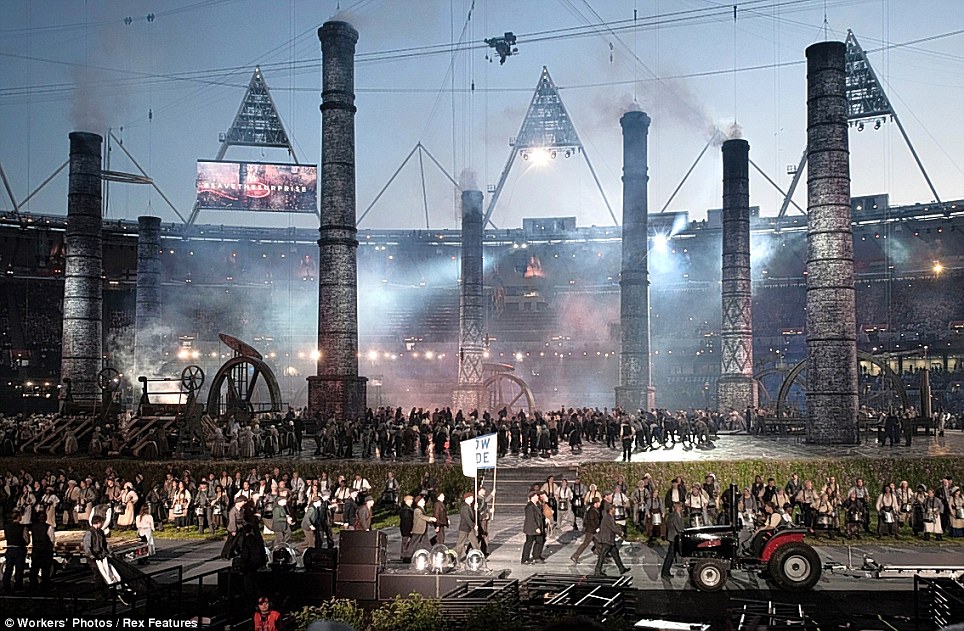
    • Men in Victorian dress enter and transform the "Green and Pleasant Land" into "Pandaemonium" (the capitol of Hell in Paradise Lost) symbolizing the Industrial Revolution
    • Olympic Rings forged and raised
  • Video of James Bond escorting the actual Queen Elizabeth onto a helicopter, actors base jump from helicopter above the stadium
  • Queen of England arrives with dignitaries
  • National Anthem performed by the Kaos Singing Choir for Deaf and Hearing Children
  • "Isle of Wonder" artistic segment ctd.
    • National Health Service segment with nurses and children dancing on beds
    • Children's dreams and nightmare segment featuring prominent figures in British literature
    • "Chariots of Fire" performed with comedic routine by Rowan Atkinson's Mr. Bean
    • British Pop Culture segment featuring pop music and television of the past century with dancers and subplot love story
    • "Abide with Me" performed Emeli Sande with dance by Akram Khan commemorating those lost in the 7/17 London terrorist attack in 2005, the day after London won the election to host the games (not aired in the US)
  • Parade of Nations
  • "I Bet you Look Good on the Dancefloor" and the Beattle's "Come Together" performed by the Arctic Monkeys as doves on bikes ride and fly among the athletes
  • Queen of England declares the games open
  • Olympic Flag raised to the Olympic Hymn (unsung)
  • Olympic Oaths taken
  • Olympic Flame arrives at the stadium; Cauldron lit by seven young athletes: Callum Airlie, Jordan Duckitt, Desiree Henry, Katie Kirk, Cameron MacRitchie, Aidan Reynolds, and Adelle Trace
  • "Hey Jude" performed by Paul McCartney
Photos
2012 London Olympic Gold Medal

Torch from the 2012 London Olympics

Official Logo of the 2012 London Olympics
London 2012 Olympic Cauldron
Opening Ceremony of the 2012 Olympics in London

Opening Ceremony of the 2012 Olympics in London

Wednesday, July 11, 2012

1948 London Summer Olympic Opening Ceremony

www.olympicceremony.org
1944 London - Helsinki 1952

The Games of the XIV Olympiad
London, England
1948

Opening Ceremony of the 1948 Olympics at Empire Stadium (Wembley Stadium) in London


Olympic Ceremony Records
italics indicate records at the time
  • First City to Win Election as Host City Three Times (1908, 1944 not held, 1948)
  • First Opening Ceremony Requiring Athletes to Not Give Olympic Salute (This was a salute with the hand held up and outstretched with palm down - identical to the Nazi salute - you will notice many old films on this site show the Olympic salute.  Because of the similarity, the salute was banned.)
  • Only Olympics Awarded Without a Vote (unanimously given host after the 1944 London Olympic games were cancelled)
  • Most Nations Participating (59) - Previous Berlin 1936 (49)
  • Most Athletes Participating (4,104) - Previous Berlin 1936 (3,963)


Olympic Torch Records
italics indicate records at the time
  • First Torch Carried by Ship
  • Longest Olympic Torch Relay - 3,160km (Previous Berlin 1936 3,075km)
  • Most Nations Traveled - 7 (tie - Berlin 1936)

Opening Ceremony
Empire Stadium - Wembley Stadium (85,000)
July 29, 1948

Video
(substantial color video) It may take a while for the video to load depending on your internet connection.


Opening Ceremony Highlights
The Opening Ceremonies for the 1948 Olympics were modest and highly ceremonial.  No announcements were made within the stadium during the ceremony and very little artistic elements were utilized outside of an enormous choir.  It had been 12 years since the last Olympics in Berlin and the London organizers agreed to run a torch relay to generate excitement, hoping the Olympic Games wouldn't become a casualty of WWII.  This was a contentious debate since the Nazis originated the torch relay. Thankfully, the relay was very successful and the Olympics survived; unfortunately, the ceremony program was significantly simplified because of interest within the UK, budget, time constraints, and television broadcasting.  An artistic highlight was music by Roger Quilter, one of the greatest composers in music history, who composed the Olympic Hymn.  Here is the short summary of the ceremony:
Photos
Gold Medal from the 1948 London Olympics

1948 London Olympic Torch

Official Poster of the 1948 London Olympics

The 1948 Olympic Cauldron at Empire Stadium (Wembley Stadium)

1944 London Summer Olympic Opening Ceremony


The Games of the XIII Olympiad
London, England
1944


Olympic Ceremony Records 
italics indicate records at the time

  • Third Olympic Games to be Canceled (World War II)
Opening Ceremony
Empire Stadium - Wembley Stadium (82,000)

Video
No Video

Official Report
No Official Report

Opening Ceremony Highlights
The 1944 Olympic Games were canceled due to World War II.  Very few reports exist of the plans for the London 1944 games. It was assumed the ceremonies would be staged at Empire Stadium (Wembley Stadium) but the games never took place.  The 1948 games were awarded to London as well, without a vote, due to their suffering and triumph of the previous decade.

Wednesday, July 4, 2012

1908 London Summer Olympic Opening Ceremony

www.olympicceremony.org
1906 Athens - Stockholm 1912

The Games of the IV Olympiad
London, England
1908
White City Stadium - host of the Opening Ceremony
Olympic Ceremony Records
italics indicate records at the time

  • First Parade of Nations by Country in an Official Olympics (originated 1906 Intercalated Games)
  • First Playing of the National Anthem at an Official Opening Ceremony (The Star-Spangled Banner was performed in 1904 but it was neither the official National Anthem of the U.S. nor was it an official Opening Ceremony)
  • First Parade of Nations to Use a Standard Displaying the Country Name
  • First Competitions in Winter Sports (Figure Skating) - These games were split into Summer Games and Autumn Games, figure skating obviously being competed in the later.
  • Largest Stadium to Host the Opening Ceremony (68,000) - previous Athens 1896 (45,000)
  • Most Athletes Participating (2,008) - previous Paris 1900 (997)
  • Most Olympic Events (110) - previous Paris 1900 (95)
Opening Ceremony
White City Stadium (68,000)
July 13, 1908

Video


Official Report
(photos of the ceremony at the end of the report)


Opening Ceremony Highlights

The London Olympics of 1908 were anticipated to be the greatest Olympics yet.  Only the two previous games in Athens were successful; Paris and St. Louis were poorly run and part of the World's Fair.  Rome was the city elected to host, but with an eruption of Mt. Vesuvius in 1906, the games were moved to London.  The Opening Ceremony of the 1908 games began the modern tradition and grandiosity of the modern Olympic ceremonies.  Even though the stadium seated 68,000 there had been rain all day and only 40,000 spectators attended the ceremony.

  • King Edward VII of England arrives with many dignitaries to the Stadium
  • The first Parade of Nations by country in an official Olympics began (1906 games are not considered an official Olympic Games).  This was the highlight of many of the following Opening Ceremonies as this was in the height of the Nationalist age - which led to WWI.
  • The King of England declares the games open
  • Trumpeters sounded a fanfare
  • Band played the National Anthem
  • The athletes and crowd sound three "God Save the King" chants
  • The athletes left the field and the first track events began
Photos


Gold Medal from the 1908 Summer Olympics in London

Olympic Program Cover from the 1908 Summer Olympics in London


Opening Ceremony of the 1908 Olympics

Tuesday, September 6, 2011

6 Classical Music Pieces to Commemorate 9/11 - #6 The Star-Spangled Banner

The Star-Spangled Banner
The National Anthem of the United States of America
Lyrics from Francis Scott Key's poem "Defence of Fort McHenry"
Music from John Stafford Smith's "To Anacreon in Heaven"

O! say can you see by the dawn’s early light,
What so proudly we hailed at the twilight’s last gleaming,
Whose broad stripes and bright stars through the perilous fight,
O’er the ramparts we watched, were so gallantly streaming?
And the rockets’ red glare, the bombs bursting in air,
Gave proof through the night that our flag was still there;
O! say does that star-spangled banner yet wave,
O’er the land of the free and the home of the brave?

Why it was influenced by September 11:  The national anthem provides a great sense of national pride in Americans.  Of course, we associate it with the Olympics and many other sporting events.  After the attacks, musically, the national anthem went through a brief transition away from popularizing the tune.  In 1968, Jose Feliciano became the first to sing the national anthem in a pop style during the World Series.  Since then, many of the great pop, jazz, blues, country, and other genre specific singers applied the national anthem to their style.  This caused controversy initially, however it has since became a part of an artist's prerogative.  After the attacks, the country responded by preferring the strength of the classical, militaristic form of the national anthem and to more classic pop songs, like God Bless America, than to any more modern pieces like God Bless the USA.  By programming the national anthem in such a way, it allowed the public to vent and live their pain, anger, and fortitude through the power of the universally recognized, stately version of song.  Just like a little folk tune, everyone could participate and unify in the same melody - something difficult to do in popularizations.  This was our song.

What to listen for: The bass line (each of these examples have slightly different versions). I know we all know this song pretty well.  Essentially, when we hear the national anthem, people concentrate on the melody and the words (especially stuff about rockets and bombs - and the home of the brave - or the home of the Chiefs if you're from Kansas City).  This time, notice the bass line along with the melody.  See how it colors the melody differently; how it provides gravity into the unison parts on "twilight's last gleeming" etc. and how it provides great tension until the very end.  This is the beauty of chorale tunes.

Here is an example played at the changing of the guard at Buckingham Palace in London after the attacks.  Try to forget that they don't repeat the first phrase...give them a break! They're British!


Here is a stunning example of one of the world's greatest orchestras, The Cleveland Orchestra, in they're tribute concert in September of 2001.  Notice how vigorous the audience is belting (as well as the conductor).


This even spilled into church services.  Here is an example of the National Anthem played at a memorial service at St. Paul's in London.


Finally, one of the greatest moments, and one that I have never forgotten.  The 2002 Winter Olympics were in Salt Lake City, Utah only a few months after the attacks.  The Opening Ceremony was a gigantic tribute to our country in a grand spectacle that since that time we have yet to replicate.  However at the moment of the National Anthem, the whole ceremony stopped and this is how it played out...


We learned a lot about America because of the events of 9/11.  In music, our collective hearts were warmed to an idea that the simple form of our National Anthem provided a great expression of our sorrow, fear, and pride.  This simplest form, without any added artistic desires from pop stars or others, became a healing power for us all.  There was nothing more comforting than our song during such a terrifying and traumatic time.

Featured Post

OLYMPIC CEREMONY DATABASE: Every Summer and Winter Olympic Opening Ceremony

The opening ceremony of the Olympic Games may be the largest art form in the modern world and certainly one of the rarest.  I provided all ...